

1. Do I need the Daggerheart cards to play?
No. The cards are mostly for convenience, not a strict requirement. The core rulebook includes all the card text, and printable PDFs of every card are provided online here. In fact, the official playtest guide notes that you can download and print the Ancestry, Community, Domain, etc. cards at home, and the book’s reference section even lists all their text. Critical Role’s site likewise points out a “printer-friendly version of all the cards” is available. In practice, having the physical cards (or printouts) is handy for quick reference, but you can run Daggerheart entirely from the book or PDFs without buying extra decks.
2. Does Daggerheart use a d20 (what kind of system is it)?
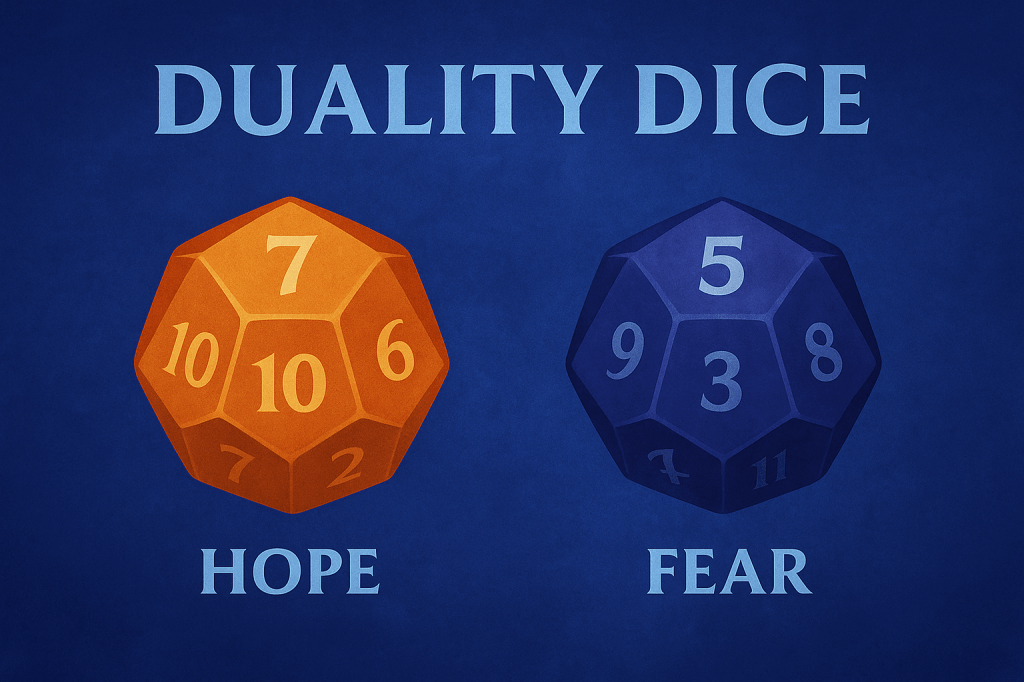
Daggerheart is a D12-based system. While d20s are still in the game, Daggerheart replaces D&D’s single d20 system with two 12-sided dice: a “Hope die” and a “Fear die”. You roll both dice and add your modifiers: a total of 13 or higher usually means success. Whether the Hope or Fear die is higher determines the narrative effect. Rolling with Hope (the higher die is Hope) gives your character a bonus token to spend, while rolling with Fear (Fear die higher) imposes a complication or drawback on the GM’s side. In other words, Hope/Fear function like dynamic advantage/disadvantage with storytelling twists. This bell‑curve 2d12 system makes mid-range results most common (unlike the flat d20), so skilled characters tend to succeed steadily without the wild swings of a single d20 roll.
3. How do I build a character? (Classes, race, etc.)
Daggerheart uses a mix of cards and choices rather than D&D’s tables. You draw Ancestry and Community cards for your character (Ancestry is like race, and Community is like cultural background). For example, the Galapa card is an Ancestry (a turtlefolk race). You also choose a Class and Subclass (e.g. Knight, Mage, Trickster) and select two Domain decks for abilities. Many of your powers come from Domain cards you pick as you level up, instead of a fixed spell list or skill tree. In short, character creation looks like: pick your Ancestry and Community (instead of race/background tables), choose a Class/Subclass, and then draw or select your starting Domain cards. Each class mixes two Domains, giving a unique set of abilities. This card‐based approach means you’re literally holding your character’s options in hand rather than flipping through a long list of tables.
Daggerheart Character Creation Made Simple
4. How is combat and play different from D&D?
Combat in Daggerheart is fast and narrative-focused, not a tactical grid game. By design there are no strict rounds or movement grids – it’s more free-flow and story-driven. Instead of using measures of actual distance units, Daggerheart uses:
Melee, Very Close, Close, Far, and Very Far
Play and narrative is similar, where the GM calls for a roll when the outcome should matter to the scene. If you fail a roll, the story still moves forward: something happens (an alarm blares, a rival takes action, etc.) rather than just letting you retry infinitely. Even a successful roll can come with complications: if you succeed “with Fear,” you achieve your goal but suffer a setback or new twist. In practice this “fail-forward” approach keeps the action moving. Instead of worrying about a strict turn order or tactical min-max, play focuses on creative descriptions and consequences. Overall, Daggerheart’s combat feels more cinematic and fast-paced than 5e’s detailed encounters.
5. How do characters advance (leveling vs XP)?
Daggerheart’s progression is milestone-based rather than XP-driven. You don’t track monster XP; instead, the group levels up at story milestones chosen by the GM. As the rules note, “advancement… is completely milestone-based”. This means your character grows when plot events call for it, not by slaying creatures. There are only 10 character levels planned in the core design, so level-ups happen more slowly than 5e (often over several sessions). At each level-up you choose new card abilities (e.g. new Domain cards or subclass upgrades). The system also leans on character background – you answer shared questions and build party bonds, so the story guides your advancement as much as the stats.
6. Is Daggerheart beginner-friendly and story-driven?
Yes. Daggerheart was made to be easy to learn and very story-focused. The designers explicitly say it’s “easy to pick up for anybody”. Rules are streamlined so you can focus on narrative: for example, everyone’s core roll is just 2d12 + a modifier (no juggling a dozen skills or modifiers).
The game encourages a “fiction-first” approach: players describe heroic actions in detail, and the mechanics back up the story.
The rulebook even includes roleplaying prompts and session-questions (bonds, ideals, etc.) by default – stuff you usually add yourself in D&D. Veteran players note that Daggerheart’s built-in prompts and collaborative worldbuilding go beyond what 5e provides, making improv and character relationships part of the rules. In short, it trades some of D&D’s rules crunch for a narrative flair and easy pick-up style, which most tables (especially newer groups) find welcoming.
7. How do skills/abilities (Attributes and Experiences) work?

Daggerheart has six core attributes (like Strength, Agility, etc.) and no long skill list. Instead, each character picks a few “Experiences” – simple words or phrases that capture their expertise (for example, “Ship Captain” or “Arcane Studies”).
When you roll for something, you add the relevant attribute (with small modifiers like +0 or +1) and, if appropriate, you can spend a Hope token to apply an Experience bonus. This replaces D&D’s many skill checks and proficiency bonus with a flexible, narrative mechanic. In play, you call on whatever Experience fits the situation instead of checking a fixed skill. For example, a character with the “Alchemist” experience might add +2 to a dice roll involving potions or chemistry. As one preview notes, “Experiences represent swathes of relevant skill”. In practice this means your character’s notable backstory traits (Experience cards) and domain abilities drive what they’re good at, rather than a separate skill list.
- Sources and Pemissions:
- Artwork in this article created and owned by MymsWell – Michael K.
- Daggerheart Downloads
- Daggerheart SRD


 Mym's Well
Leave a reply to g Cancel reply